

I’ve often written and talked about China’s comparative lack of diplomatic depth in the Middle East. Its engagement has traditionally been shallow other than trade and contracting, and its diplomats and officials haven’t spent decades meeting with regional actors at the same level as other countries with deeper footprints.
I’ve also rolled my eyes a lot when I hear about the China-brokered peace between Saudi Arabia and Iran, a rapprochement that was driven primarily by domestic pressures in both countries and was well underway before Chinese involvement.
But this week China, Saudi Arabia and Iran held their third round of trilateral talks using the mechanism developed in the wake of the Beijing-hosted rapprochement, and while I don’t want to inflate the outcomes of the meetings, the fact that they take place and the increasingly wide range of regional issues on the agenda is worth noting - this is how Beijing develops its diplomatic capacity in MENA, meeting by meeting.
Beyond the Saudi and Iran specific issues, they also talked about Israel-Palestine, Israel-Lebanon, Israel-Syria, and Yemen. Its still early days, but China got the membership, it’s doing the reps, and its building the muscles.
As per WANA, the next round of meetings will be in Beijing.
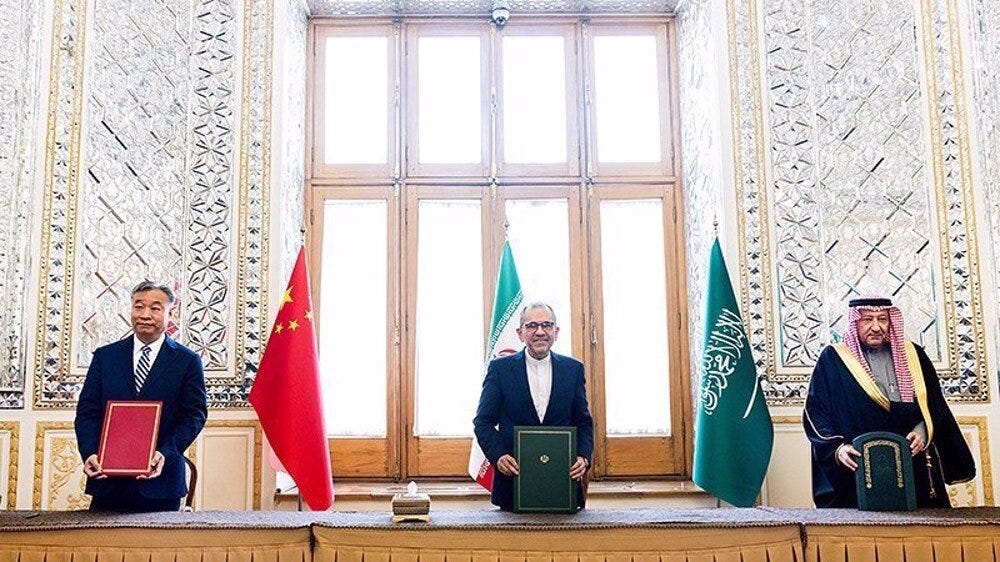
Iran hosts trilateral meeting with China and Saudi Arabia - Iran International.
Iran, China and Saudi Arabia held a trilateral meeting in Tehran on Tuesday, the third since their 2023 normalization agreement brokered in Beijing, state media reported.
Deputy Foreign Minister Majid Takht-Ravanchi headed the Iranian delegation. A preparatory session with diplomats and experts from the three countries was held on Monday, according to ISNA.
The meeting reviewed progress in implementing the Beijing accord, which restored diplomatic relations between Tehran and Riyadh after a seven-year rift and set out commitments to reopen embassies and expand political and economic ties.
According to China’s foreign ministry, the three sides called for an immediate halt to Israeli actions against Palestine, Lebanon, and Syria, and condemned violations of Iran’s national sovereignty and territorial integrity. The statement also said the parties look forward to expanding cooperation in various fields, including economics and politics.
The previous rounds of the trilateral committee were held in Beijing and Riyadh, where the sides reaffirmed respect for sovereignty and non-interference and welcomed China’s continued mediation to support regional dialogue.
China backs expanding Iran–Saudi ties at trilateral meeting - Tehran Times. The Tehran Times gives an overview of the items covered in the joint statement, which I don’t have a copy of yet so this serves in the meantime. It’s interesting to see the regional affairs covered here.
During the session, the three sides issued a joint statement outlining key commitments and recent progress.
They reaffirmed Iran and Saudi Arabia’s dedication to fully implementing the 2023 Beijing Agreement, the China-brokered deal that restored diplomatic ties between the two nations. Both countries stressed the importance of upholding sovereignty, territorial integrity, independence, and security in line with the UN Charter, the Charter of the Organization of Islamic Cooperation (OIC), and international law.
The statement also praised China’s “continued positive role” in facilitating dialogue and overseeing the agreement’s implementation.
For its part, China reiterated its willingness to support and encourage further cooperation between Tehran and Riyadh in political, economic, cultural, and security areas.
The joint statement highlighted progress in consular coordination, noting that this cooperation helped ensure the safe travel of more than 85,000 Iranian Hajj pilgrims and over 210,000 Umrah pilgrims in 2025.
It also welcomed the expanding exchanges between Iranian and Saudi research centers, universities, media outlets, and cultural institutions.
Addressing regional issues, the three countries called for an immediate end to Israeli military operations in Palestine, Lebanon, and Syria, and condemned violations of Iranian sovereignty.
Iran’s representative expressed appreciation for the steadfast support shown by Saudi Arabia and China during Israel’s June aggression against Iran.
The parties further reaffirmed their backing of a comprehensive, UN-led political solution in Yemen.
And if you’re interested in a deeper dive into China’s role in the Saudi-Iran rapprochement in 2023, I’d once again recommend this article by Niloufar Baghernia, an Iranian PhD student in Australia. I spoke with Niloufar about China’s role in the Iran-Saudi rapprochement last year - you can check out the video here.
CHINA’S MARGINAL INVOLVEMENT IN THE 2023 IRAN-SAUDI ARABIA RECONCILIATION - Niloufar Baghernia, Asian Affairs.
Abstract:
The restoration of diplomatic relations between Iran and Saudi Arabia in March 2023 has been described as a landmark in China’s advancing engagement in Middle Eastern affairs. This article argues, however, that China’s role in the deal was minimal and that the main drivers of the agreement were Iran and Saudi Arabia’s own objectives and concerns and, in particular, Saudi Arabia’s growing economic and military power. China’s greatest influence resulted from its intervention on the side of Saudi Arabia and the other Gulf Arab states and the Tehran leadership’s perceptions that Beijing’s commercial interests were leading it to side with Riyadh. The Iranian government’s fears were exacerbated by concerns about mass protests in Iran in 2022 and the outcomes of the China-GCC Summit in December of that year. At the same time, Saudi Arabia chose to de-escalate its confrontation with Iran to strengthen its regional and global power underpinned by the huge Vision 2030 development programme.
Joint Statement on the Launch of the Group of Friends of Global Governance - PRC Mission to the United Nations. Another China-centered grouping has predictably emerged, not long after the Global Governance Initiative was announced. The Group of Friends of Global Governance, comprising 43 countries, held its first meeting at the United Nations Headquarters on 9 December 2025. Arab League members and/or regional countries are Comoros, Djibouti, Iran, Libya, Mauritania, Morocco, and Palestine. The statement isn’t especially long but I’ve just included the two paragraphs that highlight China’s position within the group:
We underscore, in this context, the urgent need to reform and improve global governance to make it more relevant and responsive to an emerging multipolar world. We welcome the Global Governance Initiative proposed by Chinese President Xi Jinping, and its five core concepts—sovereign equality, international rule of law, multilateralism, a people-centered approach and taking real actions. We further appreciate that the Initiative, anchored in the purposes and principles of the UN Charter, aims to uphold multilateralism and reinforce the central role of the UN in international affairs.
We affirm that the establishment of the Group of Friends of Global Governance marks a significant step in implementing the Global Governance Initiative, and provides an inclusive platform that draws on collective wisdom and mobilizes joint efforts for reforming and improving the global governance system. Through this Group, we commit to deepening dialogue and coordination on global governance issues, engaging with relevant stakeholders, amplifying our collective voice, building and expanding consensus, and delivering concrete outcomes that respond to the yearns of our peoples and the legitimate aspirations of our nations.